I’ve always loved to read and wonder about extinct civilizations and the mysterious artifacts they’ve left behind. I’m fascinated by old things, imagining what life would have been like in a certain place at a certain time.
Maybe it was due to me and my sisters watching all the Indiana Jones movies over and over as a kid. I really wanted to be an archaeologist when I was 12 years old. While other girls our age were starting to have boyfriends and collect teen magazines, my cousin Kat and I spent hours perusing rock piles at the neighborhood park pretending to find arrowheads, stone tools, and buried treasure. Mainly we just found a few mollusk shell fossils (very common in the Philippines) – maybe we should have aspired to paleontology instead!
I guess that’s why I decided to do the 3-hour road trip from Rome to Pompei. The weather was very cool and as I walked briskly towards Piazza del Popolo, where we were told to meet up, I was glad I’d decided to wear a sweater.

I had pre-booked a seat on a bus tour, and the scenery along the road was gorgeous. Green fields, lush trees, flocks of sheep, and the occasional house would flash by. We learned about the monastery of St. Benedict on Monte Cassino (where the Benedictine Order was born in 57 AD) as we gazed at the abbey perched on a hill (the original monastery was destroyed by Allied troops during World War 2 and eventually rebuilt). We had a wonderful view of the Apennine mountains and I noted that the left side of the bus would have been much better to take pictures from.
I was the nerd onboard who relentlessly scribbled notes in a journal as our guides, Emiliano and Antonella, took turns speaking into the microphone that fed into to our wireless radios and headphones (the former in Italian and the latter in English). They told us about the history and geography of modern-day Pompei and the nearby city of Naples in the Campania region of Italy, as well as some much earlier history.
Written based on my notes, dated August 7th, 2016:
Ancient Pompeii was a bustling sea port and centre of commerce, just a few kilometers away from the base of Mount Vesuvius, which we now know as one of the most dangerous active volcanoes in the world. Prior to its notorious eruption, most of Pompeii’s 15-20,000 inhabitants had had no idea that the mountain was a volcano, as only minor earthquakes had been felt there for hundreds of years.
Then, in 79 AD, disaster struck. The catastrophic eruption covered several cities along the Bay of Naples in rocks, pumice, and volcanic ash, and engulfed them in poisonous sulfurous gas.
Pompeii and Herculaneum were completely lost, and would stay lost for 17 centuries after that fateful day. The eruption had caused drastic topographical changes in the shoreline and land formations, and both cities’ locations were soon forgotten.
Naples (Napoli in Italian or Neapolis – “New City” – in Greek) was a Greek colony, and is famous for its food. The Campania region is blessed with some of the most fertile agricultural land in the world, due to the volcanic nature of the area. Grapes grow at the foot of Vesuvius, and sweet, enormous lemons are a local specialty, as is limoncello, a lemon-based liqueur.
Naples is also the birthplace of Margherita pizza. King Umberto I, the son of Vittorio Emmanuele II (the first king of the unified Italy), paid a royal visit to Naples in 1889 with his wife, Princess Margherita. Legend has it that the pizza-maker Raffaele Esposito was tasked with creating something special for the couple, and he presented a pizza with tomatoes, mozzarella cheese, and basil to represent the colours of the new Italian flag – red, white, and green.
Ruins of Pompei
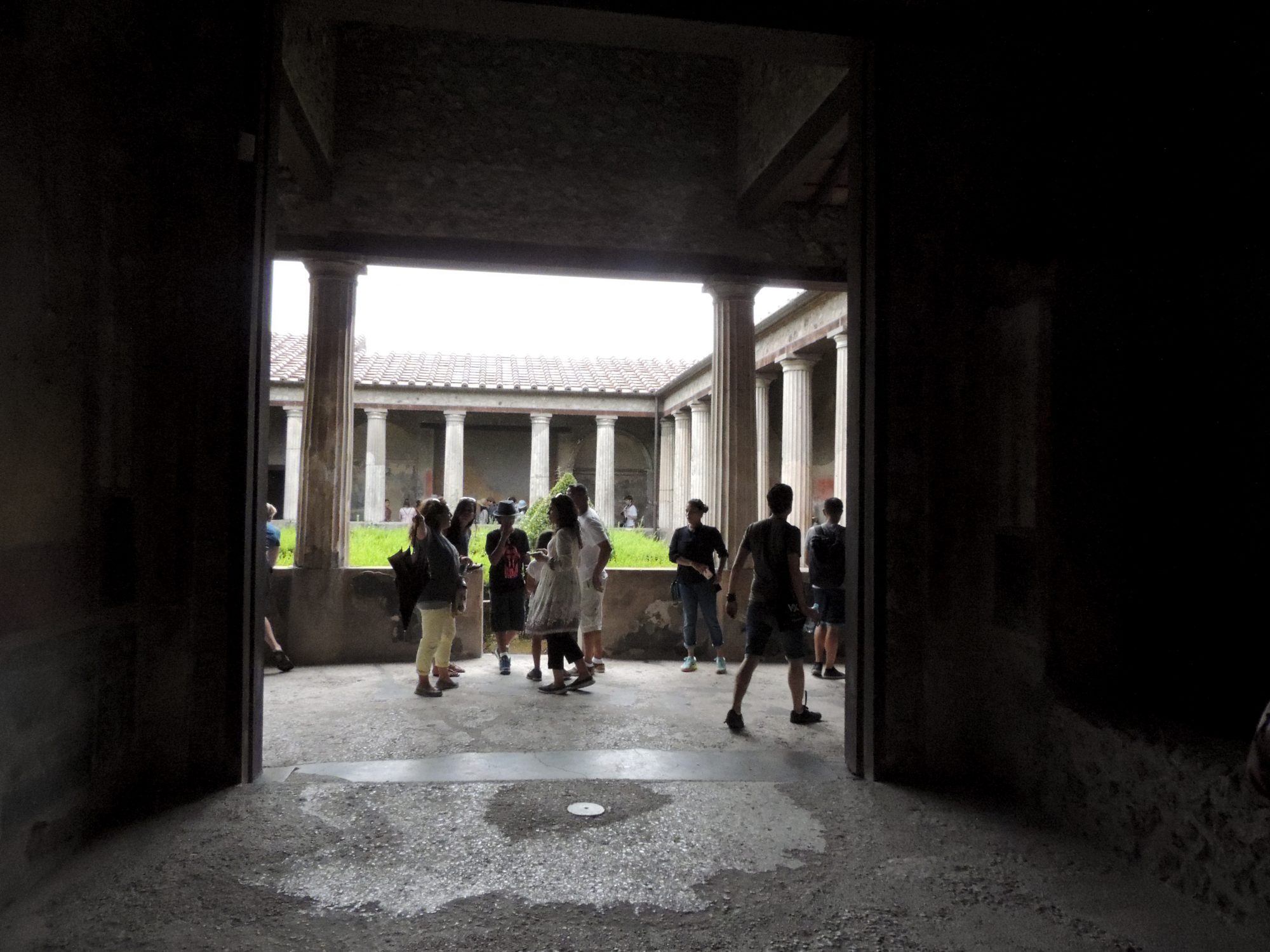
It was gently drizzling when we arrived. I was afraid to take my camera out too often so I didn’t take many photos, but the experience was all the more enjoyable as I wasn’t constantly peering through a lens.
Our local guide was named Genaro. Our group hastily scurried after him in his plastic poncho as we tried to stay as dry as possible.

As we approached the site, I saw massive, decrepit-looking bronze sculptures standing here and there. I stared at them in amazement and puzzlement – noting that Pompeii wasn’t known for such things – until Genaro told us that they were actually created by a modern artist and sent to be displayed among the ruins. I sniffed at the obvious mockery of tourism and shamelessly went on our way through the excavated site.

Unlike the scattered ruins in Rome, Pompeii’s remains have been greatly preserved in the state they were left, and protected from human pollution for centuries. I could still see the layout of the streets, the colours in the paintings, the upright columns, the intact mosaic floors and original cobblestones, the scratched graffiti on the walls.

I snickered as I surmised that the graffiti content probably wasn’t much different from the Sharpie scribbles on the wall of a modern public restroom. And to illustrate my point, here’s something that was carved into a stone in the road, a marker that pointed visitors to a local brothel:

Silly little touches like this brought the site into perspective – signs of a very human, very real civilization that once flourished here.
Genaro pointed out something most of us today would be familiar with: a political campaign sign that indicated Pompeii’s election system at the time. This “Cornelium” is thought to be a long-forgotten influential figure in the city. Now all that remains of him is a faded name, shielded from the elements by a single pane of glass, to be pondered over and briefly noted by a 21st-century tourist with a camera.

We visited abandoned bath houses, grand homes, temple ruins, and numerous storerooms filled with relics – kitchen pots and utensils, furniture, weapons, artwork.
And snapshots of death, suspended in time.
The volcanic ash of the 79 AD eruption had completely encased bodies of animals and people, forming nearly perfect casts of their dying moments. All of their remains have biodegraded, of course, but archaeologists had filled these casts with plaster, molded into the shapes of the corpses they once held. My heart was wrenched at the sight of a nameless, pregnant young woman, her face hidden in her hands. This was the figure of an actual person who lived, breathed, laughed, ate, cried, and loved.

After the tour, soggy and bedraggled, we got back on the bus and went to lunch at Ristorante Tiberius, where I had my first taste of authentic Napoli cuisine. I sat at a table with two Japanese-Canadians (Koyoko, and her daughter, Yuki, who was a nurse) and a Californian barista named Anthony. We all had a fresh green salad, Margherita pizza (I smiled as I noted the colours for the first time!), and a bottle of locally produced red wine, as we chatted about our travels. They were fascinated when I told them I worked for a church in Dubai.

After lunch, we were scheduled to go hiking up to Mount Vesuvius next. Unfortunately, there had been a terrible bus accident on the road to the volcano, and all traffic had been blocked. Disappointed, and worrying about the injured, we were rerouted to Naples Archaeological Museum instead.

Many of Pompeii’s treasures were moved to the museum after several excavations. An entire gallery, dubbed the “Secret Museum” or “Secret Cabinet” is dedicated to a particularly graphic collection of ancient erotic imagery and art that would have made their conservative Counter-Reformation discoverers blush. The collection was sporadically hidden from public view over the years, but recently became a permanent exhibit albeit requiring parental guidance for minors.
On the long bus ride home, I stared into the sunset, not even bothering to capture its beauty with my pitiful photography skills. Instead, I reflected on the passage of time, on the impermanence of life on this earth, on the material possessions and physical appearances that we hold on to so tightly only to be left behind.